

Preprints are draft manuscripts shared online before peer review, offering advantages like rapid dissemination and open access. However, concerns include potential misinformation and plagiarism risks. Public feedback is encouraged, but it may lack rigor. With growing usage post-COVID-19, understanding and guidelines are crucial for authors and editors moving forward.
Category: Writer’s Camp Feature
Writer’s Camp Features are in-depth, mentor-style articles that explore the craft, ethics, and practice of scholarly writing. These pieces go beyond quick tips to offer thoughtful guidance, practical strategies, and deeper reflections that help authors grow in confidence and skill. Each feature is written with Writer’s Camp’s signature clarity, warmth, and encouragement—supporting writers at every stage of their scholarly journey.
The Disappearing Writer: AI, Authorship, and the Fragile Future of Nursing Trust
Lisa Kelly reflects on the growing issue of AI misuse in nursing education, stemming from a personal experience with faulty citations. She emphasizes that reliance on AI threatens the integrity of nursing by eroding trust and inhibiting critical thinking. The need for transparency, vulnerability, and genuine engagement in writing is paramount to rebuild this essential trust within the profession.
Writing, Caring, Nursing Publications, and You
Jenny Chicca shares her personal journey with disabilities while emphasizing the importance of inclusive language in nursing writing. She discusses person-first and identity-first language and their implications for representation. The article advocates for careful communication to promote respect and understanding, ultimately aiming to enhance healthcare outcomes through thoughtful writing practices.
Write Better Conclusions With This One Simple Trick!

Miriam Bowers-Abbott critiques traditional conclusion writing, suggesting that instead of summarizing, conclusions should explore implications and pose questions. By analyzing examples, she emphasizes that a meaningful conclusion should find significance in findings, invite further research, and introduce new perspectives, enriching the reader's understanding rather than restating points.
Writing Effective, Timely, and Thought-provoking Editorials

Rita H. Pickler discusses the significance of editorials in journals, emphasizing their role in communicating vital trends and issues beyond typical scientific papers. She outlines key elements for writing effective editorials, including topic selection, tone, and structure, while sharing personal experiences and the importance of remaining relevant and engaging.
Proofreading for Perfection

Teresa Shellenbarger emphasizes the critical role of proofreading in ensuring a polished document. Various strategies include taking breaks, changing formats, using AI tools, reading aloud, and seeking external help. Each approach contributes to identifying errors and enhancing clarity, ultimately presenting an error-free version of one's work.
Listing of Credentials in Professional Publications

Parveen A. Ali, a nursing scholar and Editor-in-Chief of the International Nursing Review, discusses challenges surrounding author credential visibility in academic publications. Current practices typically limit author details to names and affiliations, raising concerns about understanding author expertise. A push for uniformity and transparency in credential presentation is advocated for nursing and other disciplines.
Writing as Storytelling: An Homage to Bob Keddell

Jenny Chicca honors her father, Bob Keddell, a fun-ducational expert and camp director, sharing stories from their time at ECRC summer camps. Bob's unique approach combined learning with storytelling, emphasizing the importance of engaging narrative in writing. His legacy inspires others to tell their stories with curiosity and humor.
Cultivating the Publishable Writer Within
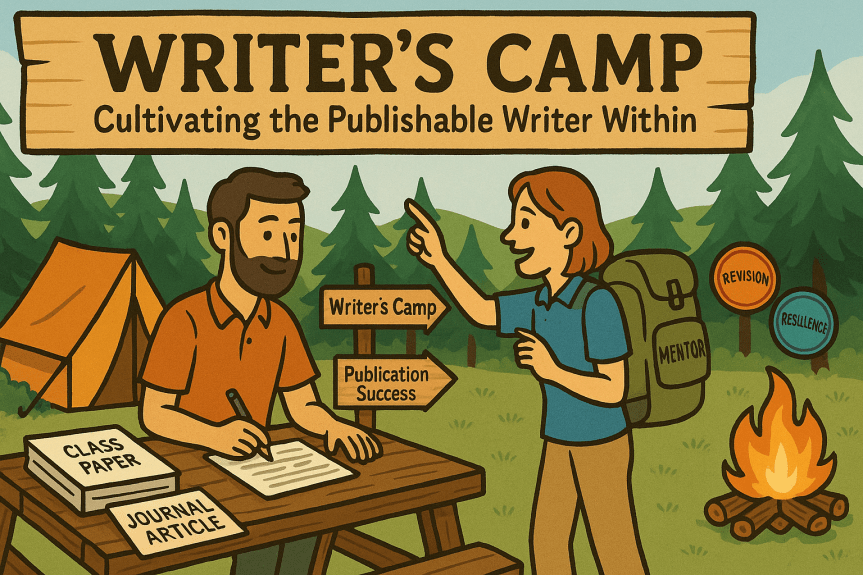
In Cultivating the Publishable Writer Within, Faith A. Tissot guides budding scholars in transforming academic assignments into publishable manuscripts. She highlights the need for persistence, resilience, mentorship, and daily writing. Drawing on Writer’s Camp resources and personal experiences, she shows how feedback and revision build confidence and lead to publication success.
Email Hints and Caveats: Advice for Authors

The content discusses essential email etiquette for professionals, particularly authors and editors. Key points include the importance of using a simple, professional email address, maintaining consistency in contact details, creating a clear signature with necessary credentials, and ensuring attention to formatting. Adhering to these standards enhances communication and reflects professionalism.
REFRAME Rejection: Practical Tips for Developing Rejection Resilience

Brad Phillips discusses the inevitability of manuscript rejection and its emotional impact on early-career scholars. He outlines strategies to build rejection resilience, including realizing rejection is normal, examining feedback, and seeking clarity. By sharing experiences and engaging in peer review, authors can prepare for future challenges in the publication process.
Using Generative Artificial Intelligence for Reformatting References in Scholarly Writing

Generative AI tools like ChatGPT are impacting nursing scholarship by assisting in various tasks, but concerns about accuracy, bias, and plagiarism persist. Authors must ensure the reliability of AI-generated content and disclose its use in their work. For reference formatting, traditional management software is more reliable than AI.