

Teresa Shellenbarger, PhD, RN, CNE, CNEcl, ANEF
Writer’s Camp Counselor
Abstract
Teresa Shellenbarger emphasizes the critical role of proofreading in ensuring a polished document. Various strategies include taking breaks, changing formats, using AI tools, reading aloud, and seeking external help. Each approach contributes to identifying errors and enhancing clarity, ultimately presenting an error-free version of one’s work.
Careful attention at the proofreading stage is vitally important.
Your document is written, and you think the work is finished, but there is one crucial last step you must take: proofreading. Yes, you have already read your document repeatedly, but you may have missed something while focusing on the content. You want your document to be accurate and not have proofreading errors that will distract from your message. Submission of a document that has errors gives the impression of sloppy or careless writing and may lead readers to express concerns about the accuracy of the rest of the work. Poor proofreading presents the wrong impression. You can avoid these problems and take steps to ensure that your work presents error-free, polished writing.
There are a variety of approaches you can use to ensure that your document is proofread and polished. You can decide which approach works best for you. You may even use more than one of the following strategies.
Reading Approaches
One proofreading tactic many writers use is to take a break from the writing and return later for proofreading. I like to wait a day or two and re-read the document. After a brief wait period, return to your work and carefully read your materials before finalizing. Sometimes, you see your writing from a fresh perspective when you review it later.
Proofreading in the original format does not always allow easy identification of errors. A new format or layout can be helpful. Changing the font size or style can help spot errors when rereading your work. You may see your work from a new perspective and catch errors that you did not notice before.
If you read the document in electronic format, switch from one computer type to another. For example, switch to an iPad instead of reading on your laptop and re-read the document. Sometimes, this simple change provides a different perspective that allows you to spot errors more easily.
Another trick is to print out the document for proofreading. Reviewing your written work on paper gives you a new perspective that is different than reading on a computer screen. If you print out the document, covering most of the page and revealing each line as you read is helpful. I like to cover my document with a blank piece of paper and reveal each line as I read. Others suggest using a ruler to stay focused on the line of text that is read. This method of uncovering lines as you go may prevent you from skipping ahead or skimming the writing.
While reading, pretend that the work is written by someone else. Do not automatically fill in the words but read carefully as you would if you reviewed someone else’s document. Another tip that is sometimes shared is to read the document backward. Start at the last page and read from right to left. This will slow down the reading and help identify spelling errors. It will probably not help you identify omitted words, grammar, or content problems and you will need to rely on other proofreading approaches for those issues.
Leverage Artificial Intelligence
With the rapid explosion of artificial intelligence (AI), writers may rely on grammar checkers such as Grammarly to assist with proofreading and editing. These AI options can be extremely helpful in identifying punctuation and grammar problems. They will frequently also help to identify duplicate or missing words in a document. As with any AI program, reviewing the output and ensuring you agree with the recommendations is always essential. Sometimes, the suggestions offered by AI grammar checkers may not be correct or may not convey your message appropriately. Always review the AI-generated suggestions. You can accept or reject the changes.
Another caution with AI use relates to the type of platform or program you are using. If the system is not protected or “closed,” you may be uploading your work to a public domain that will make it accessible to others. For items that contain proprietary or intellectual property, this is a concern. Always check the privacy settings for any AI program you are using. Determine how uploaded information will be used by others and decide if you wish to use these programs.
Listen to the Language
Another proofreading suggestion relies on the spoken word. Use audio to help detect errors in your document. You have two choices for how to listen to your language. Some people like to read the document aloud. Hearing the words spoken may help you to identify problems with the writing. Reading aloud also helps you to read more slowly and not skip over words. When using this proofreading approach, I find it helpful to follow along with my finger as I read each word. Read one word at a time, and do not skim or skip ahead. Stay focused as you read. If you find your mind wandering during this activity, take a break. Review each word and not as a complete sentence. For example, you would read “I. love. to. write. and. edit.” Rather than reading, “I love to write and edit.” Do not rush during this activity. Stay focused on reading aloud. If you are reading a lengthy document, such as a book chapter or dissertation, you should read a section at a time. It may be helpful to take a break between sections. This reading-aloud approach may help identify awkward wording or repetitive words and phrases in the writing. When you use this proofreading approach, you may also become more aware of the length of sentences or when punctuation is needed due to pausing when reading.
An alternative to reading aloud to yourself is using your word processor’s audio or reading feature. This feature will read the text for you. You can simply listen to the reading to detect any problems.
Seek Help From Others
Sometimes, you are tired of re-reading a document, especially if you have been working on this writing project for a long time. If so, consider asking a colleague to proofread the document for you. The person you choose does not have to be someone with expertise or content knowledge in the area. They are reading to ensure the writing makes sense and does not have errors. You may want to consider colleagues in your discipline to serve as your readers. You can develop a proofreading partner arrangement in which you agree to read each other’s papers.
You can also seek out people who may not be familiar with the topic or discipline but have good writing skills. English teachers or writing tutors may serve as good external editors. Even family members may be willing to perform this task. My family, none of whom have a healthcare background, have been invaluable in proofreading my work, and they frequently help to identify gaps in my writing. As an added benefit to this proofreading, they learn a lot about nursing and what I do by reading my writing.
Specific Aspects
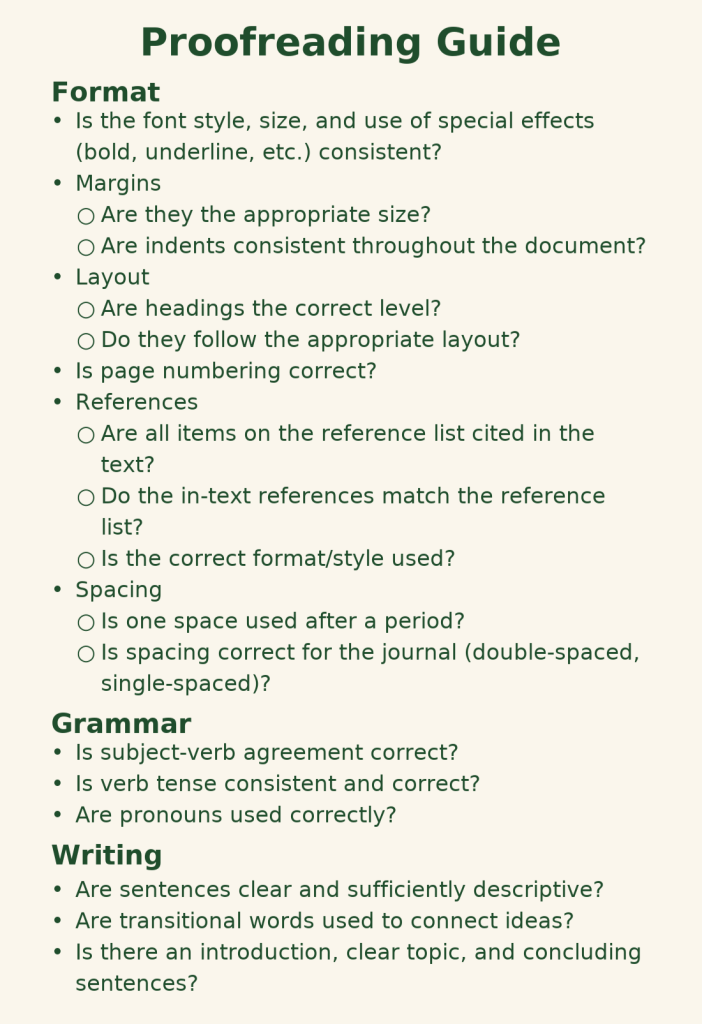
When proofreading, I find focusing on one aspect at a time helpful. Creating a standard checklist of things to review is useful and can get you into a routine for proofreading. See the “Proofreading Guide” for areas to proofread. For instance, I might do a review for formatting. That will be the final check to ensure I have followed writing guides such as spacing, fonts, and margins. I still struggle to use one space after a period instead of the two I originally learned. Knowing that this was a challenge for me, I read my documents one time to check the spacing after the period and ensure I only used one space. Individualize this proofreading guide to meet your needs.
Another proofreading review may focus on grammar and sentence structure. If you commonly make the same mistakes, keeping a list of errors or items to check when proofreading is helpful. You can add that to your review checklist. For example, you may check for pronoun use, apostrophe use, commas, sentence fragments, verb tenses, or other errors. Conduct one proofreading of the document to specifically check for these grammar issues.
Conclusion
Find the best combination of approaches to use for proofreading. With time and practice, you may see emerging patterns in your writing. Once you know the common writing and editing problems, you can begin to make these corrections automatically. Using these proofreading strategies should ensure your document is error-free and presents the best version of your work.
Author: Teresa Shellenbarger
Reviewed and Edited by: Leslie H. Nicoll
Copyright © 2025 Writer’s Camp and Teresa Shellenbarger. CC-BY-ND 4.0
Citation: Shellenbarger T. Proofreading for perfection. The Writer’s Camp Journal, 2025; 1(2):19. doi:10.5281/zenodo.17186888
Thank you for sharing this guide to proofreading. The checklist is especially helpful. I did want to offer a note of caution regarding the use of Grammarly and other tools that use AI. Some professors and instructors do not permit the use of AI-based programs for *rewriting* sentences and/or paragraphs, vs. using them to check for errors in spelling or word choice. Students should check with their instructors to make sure that their use of these tools aligns with course requirements.