

Jenny Chicca, PhD, RN, CNE, CNEcl
Writer’s Camp Senior Counselor and Associate Editor
Abstract
Jenny Chicca shares two successful award nominations, each written in an afternoon. Her approach combines a structured AI prompt with firsthand knowledge, specific evidence, purposeful revision, and careful proofreading to help colleagues receive the recognition they deserve.
A strong nomination starts with evidence and a personal connection.
We’ve all gotten the email—from our college or university, or perhaps from a colleague—asking us to nominate someone for an award. If you’re like me, you’re thinking of a deserving colleague, worrying you won’t fully capture their accomplishments, and wondering whether you have time to write the nomination, especially when the deadline is tight. But you can write a winning nomination in just a few hours. I’ll share two successful nominations I recently wrote, each in an afternoon. Let’s start with my colleague Leslie Nicoll, who has given me permission to share her story. Perhaps you know her? She is our Director here at Writer’s Camp.
The Materials You Need
After setting aside my initial worries, I reviewed the award criteria to decide which award best fit Leslie’s accomplishments. Two awards were offered by her alma mater, the Frances Payne Bolton School of Nursing at Case Western Reserve University:
The Alumni Award for Excellence: This award recognizes an alumna/us who has demonstrated outstanding leadership growth and has made significant contributions in nursing or related areas of healthcare.
The Distinguished Alumni Award: This award recognizes an alumna/us who has demonstrated exemplary contributions in nursing or related areas of healthcare and has continuously advocated for the advancement of the nursing profession.
Based on Leslie’s extensive contributions and the curriculum vitae (CV) she had provided, I chose the Distinguished Alumni Award.
Judge’s Eye: Dream big, but choose an award that fits your colleague’s accomplishments.
Next, I gathered the materials: Leslie’s CV, the award criteria, and the submission instructions, including the deadline. Because I knew her work, I did not need a sample. If you are less familiar with your colleague’s work, ask for one. Another time-saving resource is an artificial intelligence (AI) tool with privacy settings and terms appropriate for the information you plan to share.
Judge’s Eye: Protect your colleague’s information as carefully as you’d protect their case for winning.
The Time-Saving Prompt
A thoughtful AI prompt helps produce an accurate, relevant draft of your nomination letter. Include the following:1,2
- Award criteria;
- Candidate’s CV and, if applicable, a work sample;
- Expected tone and format;
- Placeholders for your personal connection to your colleague;
- Areas to add concrete examples of how your colleague meets award criteria;
- A strong opening and closing; and
- Your contact information.
Using the CO-STAR framework for prompt engineering, I wrote this prompt to start—yes, start—Leslie’s letter. I uploaded her CV and the award criteria with it:
Context: I am nominating my colleague, Leslie Nicoll, for the Distinguished Alumni Award from Case Western Reserve University Frances Payne Bolton School of Nursing. Attached are her CV and the award’s official criteria.
Objective: Write a nomination letter that persuasively demonstrates how Leslie meets each award criterion, using specific evidence drawn from her CV rather than generic praise.
Style: Professional and evidence-driven, similar to an academic letter of recommendation. Each claim about Leslie’s qualifications should be tied to a concrete accomplishment.
Tone: Warm but credible. Convey genuine admiration for Leslie’s work while maintaining the formality expected of an awards committee submission.
Audience: The Distinguished Alumni Award selection committee, likely composed of faculty and alumni leadership who don’t know Leslie’s day-to-day work and need to be persuaded using specifics, not familiarity.
Response: A nomination letter in standard business letter format, including:
- An opening paragraph naming the nominee and the award;
- [PLACEHOLDER: your personal or professional connection to Leslie];
- Body paragraphs mapping specific CV evidence to each award criterion;
- [PLACEHOLDER: concrete examples of Leslie’s impact];
- A strong closing paragraph restating your recommendation; and
- Your contact information: [name, title, email, phone].
Judge’s Eye: The prompt gets you a serviceable draft. Knowing your colleague—and revising purposefully—wins the award.
One more tip before we move on: ask AI to help draft your prompt. Who knows how a computer thinks better than—drum roll, please—a computer?
The Winning Revision
With an initial draft in hand, I began revising. I’ll show you examples from Leslie’s letter, starting with our personal connection.
I met Dr. Nicoll in 2017, early in my publishing journey. After receiving a particularly scathing peer review, I felt like giving up. I was angry and upset, and I wondered if I was good enough to publish. Ultimately, I realized that, although I agreed with some of the improvements suggested, the way the feedback was delivered was unacceptable. I reached out to Dr. Nicoll to see if she was interested in a publication about civility in peer review. She was encouraging and enthusiastic, and provided constructive feedback to help me and my co-author finalize the work. I received high praise for that article, including from civility expert Dr. Cindy Clark. With Dr. Nicoll’s encouragement, I have continued to write and, in just eight years, I have surpassed 50 publications. One year ago, Dr. Nicoll contacted me to join her newest venture called Writer’s Camp, which is all about excellence in nursing scholarship. I jumped aboard and was appointed to serve as an Associate Editor for The Writer’s Camp Journal. In my experiences in this role, I can safely say that Dr. Nicoll is a caring, innovative, and simply brilliant nurse, and I am so grateful for her mentorship.
Next, I simplified sentences, used active voice, and added transitions. In the excerpts below, underlining identifies emphasis words I added, and bold type identifies language drawn from the award criteria.
First, Dr. Nicoll is, without question, a foremost subject matter expert in nursing informatics, scholarly publishing, and evidence-based practice. For 30 years (1995 to 2025), she served as Editor-in-Chief of CIN: Computers, Informatics, Nursing, one of the profession’s flagship journals in health technology.
I added a few emphasis words to highlight the significance of her work.3 Use them sparingly, and support them with evidence.
In addition to her editorial leadership, her impressive scholarly output spans more than four decades and includes over 250 highly cited peer-reviewed articles, book chapters, and major texts, including the co-authored Editor’s Handbook (now in its 3rd edition) and Writing in the Digital Age: A Handbook for Savvy Healthcare Professionals. In recent years, Dr. Nicoll has led a nationally significant body of research on predatory publishing in nursing, with her collaborative team producing high-impact studies in the Journal of Nursing Scholarship, Nursing Outlook, and the Canadian Journal of Nursing Research, illuminating a critical threat to the integrity of nursing science.
Judge’s Eye: Whenever possible, pair an adjective with a number.3 “Impressive” is a claim; “over 250 highly cited peer-reviewed articles, book chapters, and major texts” gives it substance.
I also bolded words and phrases from the award criteria and checked that the letter explicitly addressed each one. If a criterion was missing, I revised the letter to include it.
Additionally, the scope of Dr. Nicoll’s presentation record is also extraordinary. Over her career, she has presented at regional, national, and international levels on topics spanning nursing informatics, scholarly writing, evidence-based practice, and editorial leadership.
Judge’s Eye: If a criterion isn’t explicitly there, a judge won’t assume it—give every criterion a visible place in your letter.
I checked that the letter began strongly and ended with a clear recommendation.
Opening: I can say without reservation that she represents the finest of nursing leadership, scholarship, and service that the Frances Payne Bolton School of Nursing has cultivated across generations. In the nearly four decades since she received her PhD in Nursing from the Frances Payne Bolton School of Nursing at Case Western Reserve University, Dr. Nicoll has distinguished herself as one of the most prolific, innovative, and significant figures in nursing scholarship and publishing.
Closing: Dr. Leslie Nicoll has spent her entire career advancing the nursing profession—through scholarship, leadership, mentorship, service, and innovation—and she does so with the integrity and vision that are the hallmarks of a truly distinguished alumna. She is highly deserving of this award. Thank you for your consideration of this nomination.
Judge’s Eye: Make your opening and closing memorable, with a clear endorsement of your colleague.
Once I was satisfied with the revisions, I checked every claim against Leslie’s CV.
Judge’s Eye: Every claim should hold up against the CV—an inflated or unverifiable claim costs more credibility than a modest, accurate one.
I then formatted the letter, using the institution’s colors in the header and footer, and added my digital signature and contact information. Keeping a PDF or JPEG of your signature handy can save time.
Finally, I proofread the letter, checked the submission instructions, and proofread once more. Whether to share the finished nomination with your colleague before submitting it is a personal decision. When someone asks me to write a nomination, I like to see it through myself. It feels like part of the honor of being asked and saves back-and-forth when time is short. When your colleague wins, though, be sure they see the final letter.
Judge’s Eye: Typos do neither you nor your colleague any favors. Check, then check again.
I submitted the nomination before the deadline and asked the university representative to confirm receipt.
Not a One-Off
I’m happy to report that Leslie accepted the Distinguished Alumni Award just a few weeks ago. The award committee told her they were “blown away” by the letter detailing her accomplishments. Those accomplishments are formidable; a well-crafted nomination helped bring them into focus. You can do the same to help your colleagues gain the recognition they deserve.
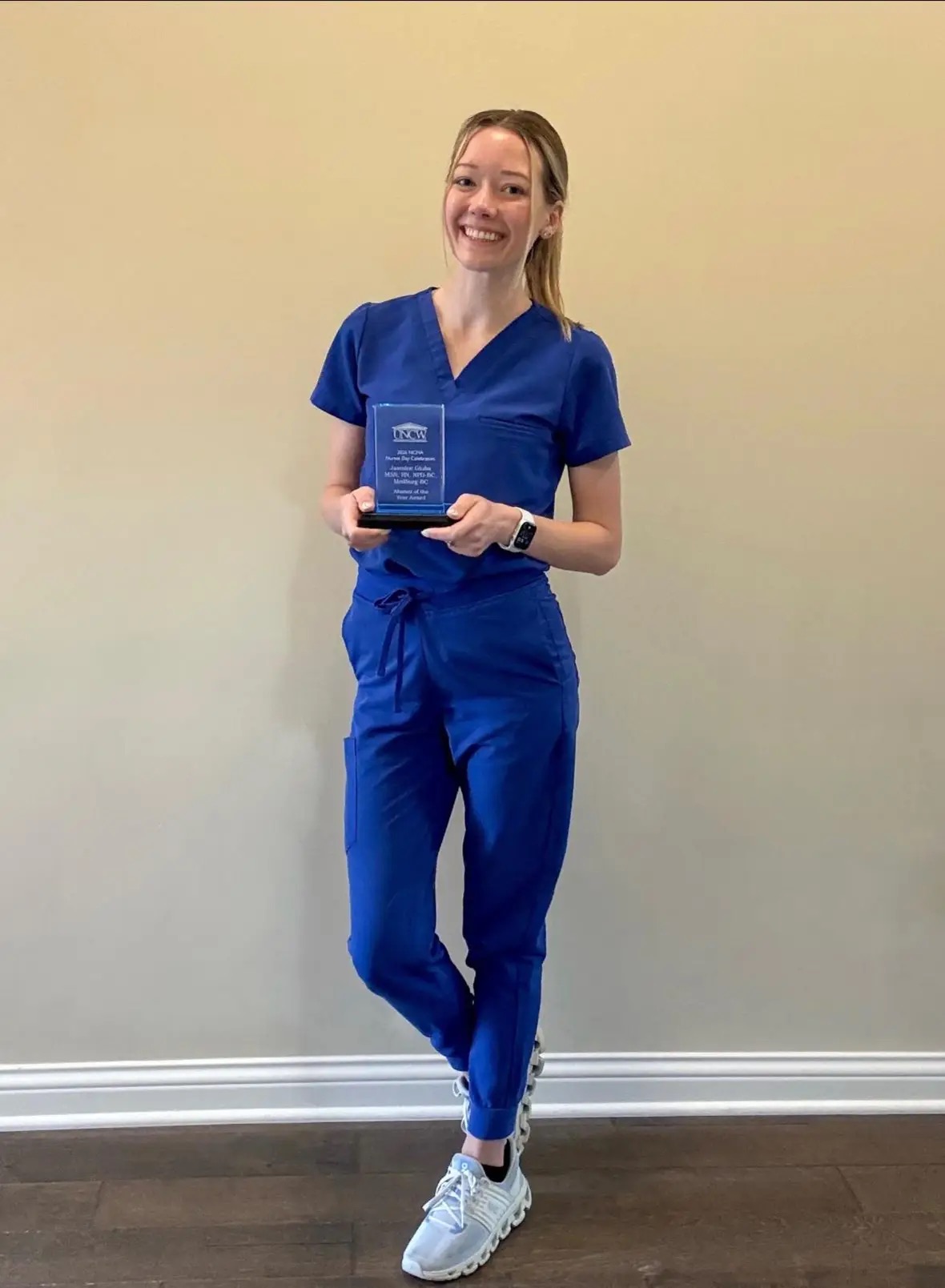
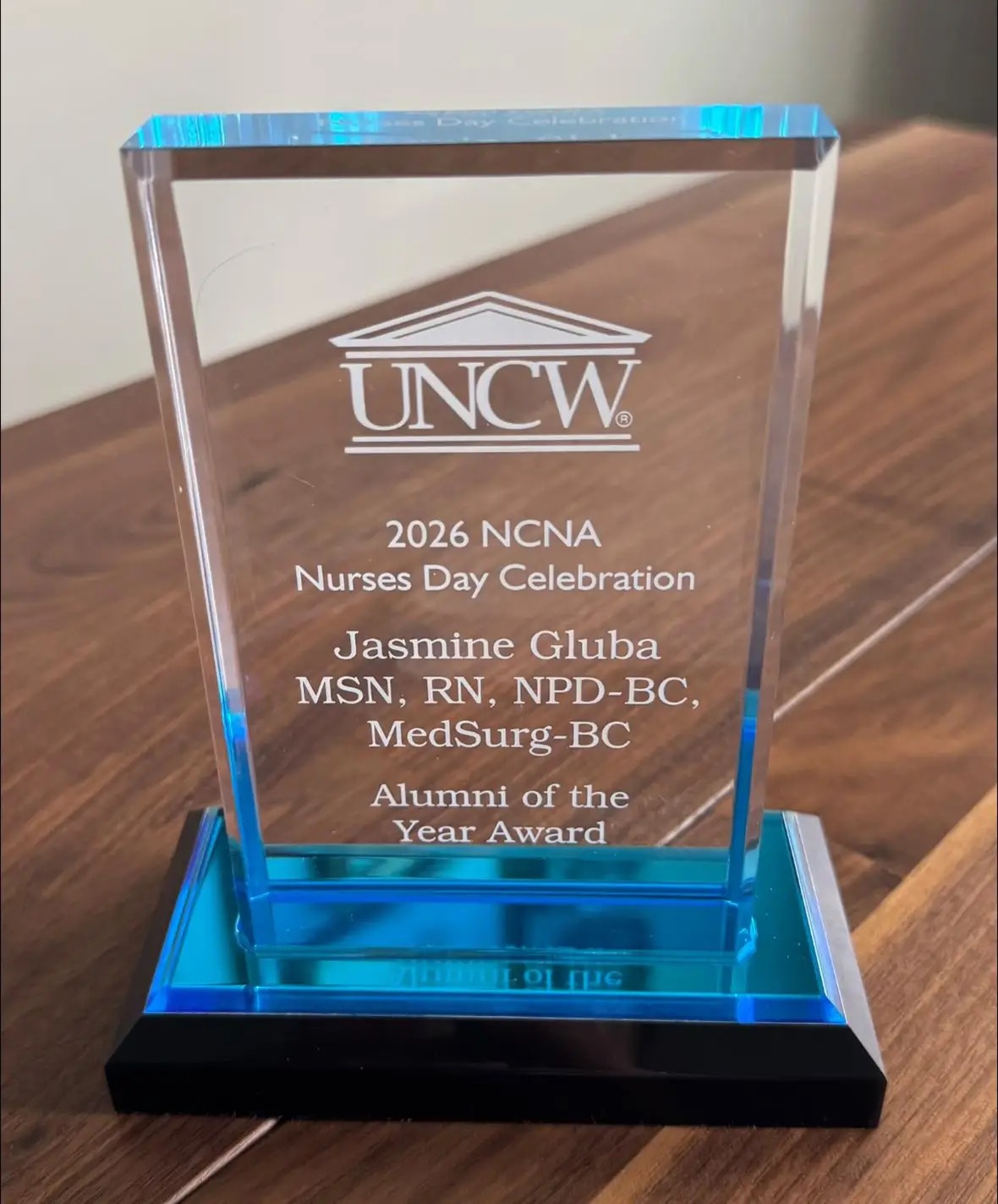
Now for the second success story. Using the same approach, I nominated a former student, Jasmine Gluba, for Alumni of the Year at the University of North Carolina Wilmington. This time, the personal connection came from my experience as her faculty member:
During her time at the University of North Carolina Wilmington, Jasmine excelled in her coursework, and I had the pleasure of working with her during her final practicum courses. I have been teaching the practicum courses for over six years, and Jasmine stands out as one of the most exceptional professionals that I have had the pleasure to teach.
Again, I paired an adjective with numbers:
Jasmine helps facilitate a significant and accredited Nurse Residency Program which serves over 100 new graduates each year, and this program boasts an impressive 87% retention rate, which is above the national average of 60%-70%.
I wrote this nomination in an afternoon, too, with just two days before the deadline. I’m thrilled to share these photos of Jasmine and her award, with her permission.
Special Considerations
These strategies also work for student recommendations, whether for further education or a scholarship. Be sure you understand the student’s goals and interests, and make the letter’s purpose clear in your prompt.
Two weeks’ notice is ideal, but a nomination or recommendation need not take long to write. If you can make time, consider saying yes, even when the deadline is tight. If you cannot offer strong support, do not know the person well enough, or lack the time, say no.
Conclusion
Writing nominations or recommendations doesn’t need to be painful or take a long time. AI can help you get started; your knowledge of the person, specific examples, and careful revisions make the letter your own. Take the time to recognize a colleague—wouldn’t you want them to do the same for you?
Declaration
Claude Sonnet 5 was used to structure the example nomination letters discussed and to check this article’s grammar and reference formatting. The author takes responsibility for the final work.
References
- University of Cincinnati. How to write a letter of recommendation that strengthens a student’s college application. Published December 2022. Accessed September 18, 2026. https://www.uc.edu/news/articles/2022/12/how-to-write-a-letter-of-recommendation-that-strengthens-a-students-college-application.html
- College Board. Tips for writing student recommendations: Teachers. Accessed September 18, 2026. https://counselors.collegeboard.org/college-application/writing-recommendations-teachers
- Georgetown University. Do’s and don’ts of writing recommendation letters. Accessed September 18, 2026. https://crf.georgetown.edu/faculty-resources/writing-recommendation-letters/dos-and-donts-of-writing-recommendation-letters/
Author: Jenny Chicca
Reviewed and Edited by: Leslie Nicoll
Copyright © 2026 Writer’s Camp and Jenny Chicca. CC-BY-ND 4.0
Citation: Chicca J. Two winning nominations, each written in an afternoon. The Writer’s Camp Journal, 2026;2(4):5. doi: 10.5281/zenodo.23674279