

Becoming an Excellent Peer Reviewer: A Writer’s Camp Learning Trail
Julee Waldrop, DNP, FNP, PNP, NC-BC, CNE, FAANP, FAAN
Staci Reynolds, PhD, RN, ACNS-BC, CPHQ, FAAN
Jayne Jennings Dunlap, DNP, PhD, APRN, CNE, EBP-C, FAANP
M. Lindell Joseph, PhD, RN, FAAN, FAONL
Writer’s Camp Counselors and Guest Counselors
Abstract
Effective peer review requires matching review criteria to the purpose of the manuscript. This article provides practical guidance for reviewing clinical, educational, leadership, evidence-based practice, quality improvement, and policy manuscripts. By emphasizing manuscript-specific evaluation, reviewers can provide more constructive feedback, support editorial decisions, and strengthen nursing scholarship.
Peer review criteria are not “one size fits all.”
Effective peer review begins by matching the review criteria to the purpose of the manuscript. Although most reviewer guidance focuses on evaluating research reports, many nursing journals publish clinically focused articles, educational innovations, leadership perspectives, evidence-based practice, quality improvement reports, and policy analyses. These manuscripts require different forms of scholarly judgment, yet reviewers often receive little guidance on how to evaluate them.
These manuscripts require a different approach to peer review than traditional research studies. Applying research criteria to a manuscript that is not a research report often results in reviews that are frustrating for authors, unhelpful to editors, and ultimately less valuable to readers. As editors, we frequently receive reviews that criticize manuscripts because they lack research questions, hypotheses, statistical analyses, or other features that were never intended to be part of the manuscript in the first place. Such reviews reflect the absence of clear guidance rather than poor reviewer performance.
The goal of peer review is not to determine whether every manuscript resembles a research study. Rather, reviewers should apply evaluation criteria that align with the manuscript’s purpose and place within the continuum of scholarly dissemination.1 Thus, the goal is to determine whether the manuscript fulfills its intended purpose, is accurate and credible, is supported by appropriate evidence, and provides value to the journal’s readership. This article will provide practical guidance for reviewers who are asked to evaluate manuscripts that are not reports of original research.
Clinical Articles and Reports
Nursing is a practice profession so therefore, clinically focused articles are common and expected in professional nursing journals. Most resemble narrative reviews, describing a clinical problem, summarizing the current evidence, and translating that evidence into practical recommendations for patient care. Unlike systematic reviews, these articles are typically intended to provide clinicians with concise, practice-oriented guidance rather than exhaustive evidence syntheses.2, 3
As a reviewer, your primary responsibility is to serve as the editor’s clinical expert. Most journals do not have staff with the specialty expertise or resources to independently verify every clinical statement after peer review. Editors therefore depend on reviewers to identify inaccuracies, unsupported recommendations, outdated information, or omissions that could mislead readers or compromise patient care. In many cases, the peer reviewer functions as the journal’s primary clinical fact-checker.
If the topic falls within your area of expertise, evaluate whether the manuscript accurately reflects current evidence and accepted clinical practice. Ask yourself whether the recommendations are clear, balanced, and appropriate for the intended audience. When you encounter information that is unfamiliar or uncertain, verify the supporting references rather than relying solely on your own recollection or experience.
High-quality clinical articles should rely primarily on current clinical practice guidelines, consensus statements, or original research rather than secondary summaries of evidence. One common problem, particularly among novice authors, is citing another author’s summary of the literature rather than the original source of the evidence. Reviewers should note these issues because accurate citation strengthens both the credibility and usefulness of the manuscript.
Perhaps most importantly, consider patient safety. Is there anything in the manuscript that could reasonably be misunderstood, misapplied, or result in unsafe clinical practice? Even well-written manuscripts require revision if ambiguity could adversely affect patient care.
Education-Focused Articles
Educational manuscripts encompass a wide variety of scholarly work, including descriptions of innovative teaching strategies, simulation activities, curriculum redesign, faculty development initiatives, assignments, and evaluation of educational programs. Although these manuscripts may not report research findings, they still contribute valuable knowledge to nurse educators and nursing education practice.
As a reviewer, your responsibility is to determine whether the educational innovation or approach is clearly described, supported by appropriate evidence, and useful to educators who may wish to adopt or adapt it in their own settings.
Ask yourself several questions while reviewing these manuscripts:
- Is the educational need or problem clearly identified?
- Is the teaching strategy or intervention described in sufficient detail for others to understand or replicate?
- Is the educational approach grounded in relevant educational theory, evidence, or best practices?
- Are the lessons learned presented honestly, including limitations as well as successes?
Some educational manuscripts evaluate courses, programs, or learning activities using formal program evaluation methods. Others may report educational research using qualitative, quantitative, or mixed methods. When educational research methods are used, reviewers should evaluate the manuscript using established guidance for research reports and applicable reporting guidelines.4-6 For manuscripts describing educational innovations or evaluations that are not research studies, reviewers should instead focus on the clarity, credibility, practical value, and educational relevance of the work.
The ultimate question is whether the manuscript provides useful knowledge that advances nursing education and can reasonably inform teaching practice beyond the authors’ institution.
Leadership-Focused Articles
Leadership manuscripts occupy a unique place in the nursing literature. Rather than presenting original research findings, they often introduce new ideas, describe innovative leadership practices, share organizational exemplars, or offer thoughtful perspectives on challenges facing the profession. These manuscripts contribute to nursing scholarship by stimulating discussion, encouraging innovation, and advancing leadership practice.⁷,⁸
As a reviewer, your role is not to determine whether the manuscript meets the standards of a research study. Instead, your responsibility is to evaluate whether it presents a thoughtful, credible, and meaningful contribution to nursing leadership.
When reviewing manuscripts that present leadership perspectives or innovative ideas, first consider whether the topic is relevant to the journal’s readership and addresses an important leadership issue. Although these papers may express an author’s viewpoint, the perspective should be grounded in current literature, leadership theory, organizational experience, or other appropriate evidence. Reviewers should look for a logical argument that builds on existing knowledge rather than unsupported opinion.
Leadership manuscripts describing organizational exemplars require somewhat different review criteria. Reviewers should determine whether the authors clearly describe the practice innovation, implementation process, methods used to evaluate success, and lessons learned. Sufficient detail should be provided so readers can judge whether the approach could reasonably be adapted within their own organizations.⁹
Regardless of the manuscript type, reviewers should also evaluate the clarity and professionalism of the writing. Is the manuscript well organized? Are the recommendations practical? Does the author encourage thoughtful discussion while maintaining a balanced and professional tone? Constructive leadership scholarship should invite reflection and dialogue rather than simply criticize existing practices.¹⁰
Ultimately, reviewers should ask whether the manuscript advances understanding of nursing leadership and provides readers with ideas they can apply in practice, or advance through scholarship.
Evidence-Based Practice and Quality Improvement Articles
Evidence-based practice (EBP), quality improvement (QI), and combined EBPQI reports use systematic methods to improve patient care but they are not research studies and therefore should not be reviewed using research reporting criteria.
Fortunately, reviewers are not expected to rely solely on their own judgment. Reporting guidelines available through the EQUATOR Network provide guidance for evaluating these manuscripts.¹¹˒¹² Reviewers can use the reporting guideline that best matches the design of the project to determine whether essential elements have been adequately described.
Editors frequently encounter several recurring problems in manuscripts describing EBP or QI initiatives. One common issue is inaccurate terminology. Authors may describe a project as “quality improvement” simply because its goal was to improve care, even though no recognized QI methodology was used. True QI involves systematic, iterative testing of change using data to guide ongoing refinement until desired outcomes are achieved.¹³
Another frequent problem is poor alignment among the purpose, methods, and results. Authors sometimes state that they intended to measure one outcome but report different outcomes in the results section, making it difficult for readers to determine whether the project’s objectives were achieved. Similarly, authors may describe one type of project while the methods actually reflect program evaluation or a quasi-experimental design.¹⁴
These issues do not necessarily warrant rejection. Rather, reviewers should recommend revisions that accurately describe the work that was performed and ensure consistency throughout the manuscript. The goal is to improve the clarity and credibility of the report so readers understand both the practice change(s) and the conclusions that can reasonably be drawn from it.
Policy-Focused Articles
Policy is an essential component of nursing practice. Provision 7 of the American Nurses Association Code of Ethics emphasizes nurses’ responsibility to participate in developing policies that influence health care, nursing practice, and society.¹⁵ Consequently, many nursing journals publish articles addressing policy at the organizational, state, national, or international level.
As with clinically focused manuscripts, reviewers should possess sufficient expertise in the topic area to evaluate both the policy issue and the evidence supporting the authors’ recommendations.
High-quality policy manuscripts clearly identify the policy problem, provide appropriate background information, summarize the current policy environment, and present well-supported recommendations for action. Those recommendations may involve developing new policies, modifying existing policies, advocating legislative change, or implementing organizational improvements.
Reviewers should evaluate whether the recommendations logically follow from the evidence presented:
- Are alternative perspectives acknowledged?
- Is the discussion balanced rather than one-sided?
- Are current policies, regulations, professional position statements, or legislative initiatives accurately represented?
Because policy recommendations often influence decision-making beyond individual practice settings, reviewers should pay particular attention to the accuracy of supporting evidence and citations.
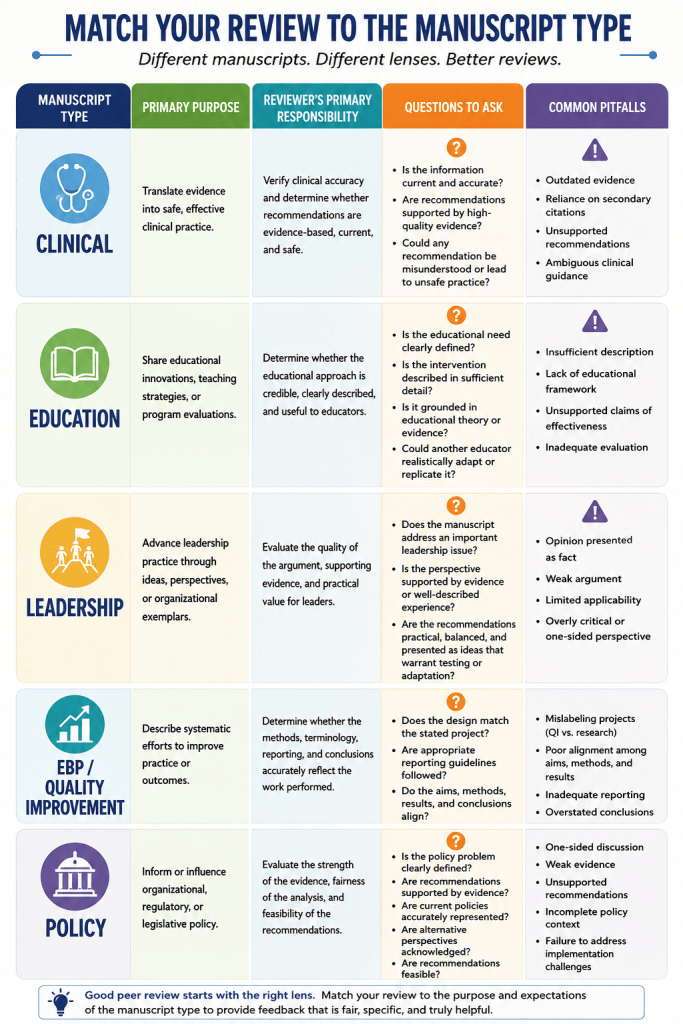
As with EBP and QI, reporting guidelines are available for policy analyses and should be consulted when appropriate.⁴ These guidelines provide reviewers with a useful framework for evaluating the completeness and organization of policy manuscripts. Table 1 summarizes the primary purpose, reviewer responsibilities, key questions, and common problems for each manuscript type discussed in this article.
Table 1.
General Considerations for Peer Review
Although each manuscript type has unique review criteria, several principles apply regardless of manuscript type.
First, accept review invitations only when the topic aligns with your education, experience, and expertise. Editors depend on reviewers to provide informed evaluations, and recognizing the limits of your expertise is an important aspect of responsible peer review.
Second, regardless of manuscript type, authors should support factual statements and recommendations with appropriate, current evidence. Reviewers should evaluate both the quality of the evidence and whether the references accurately support the statements being made.
Third, manuscripts describing EBP, QI, program evaluation, or policy analysis should use recognized frameworks, models, and reporting guidelines whenever appropriate. If you are unfamiliar with a framework or model, take a few minutes to review it before evaluating whether it has been applied correctly.
Finally, you should verify that cited references are accurate, current, and authentic. As the use of generative artificial intelligence becomes more common, fabricated or inaccurate references have become an increasing concern. Confirming that key citations are legitimate and appropriately support the manuscript is now an important part of responsible peer review.
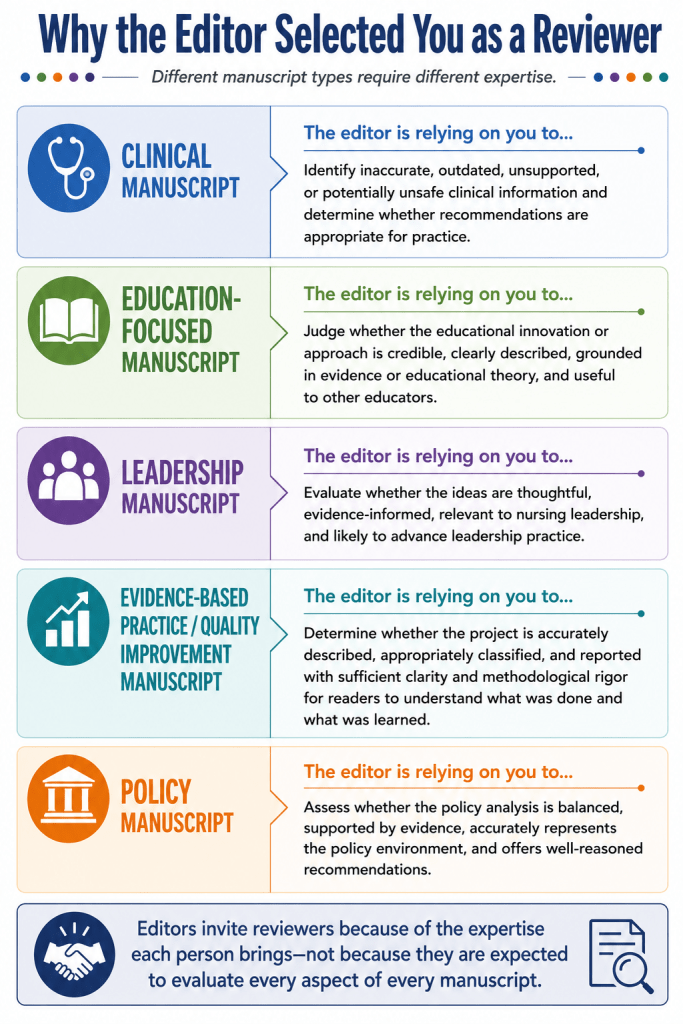
Above all, remember that these manuscripts influence clinical practice, education, leadership, QI, and health policy. A thoughtful review helps ensure that published articles are accurate, well supported, clearly written, and practically useful for readers. Keep in mind that editors select reviewers for the expertise they bring to a particular manuscript (see Table 2).
Table 2.
Conclusion
Peer review of these manuscript types requires a different set of evaluative skills than peer review of research reports. Rather than applying research criteria to every submission, reviewers should evaluate each manuscript according to its intended purpose, the quality of its supporting evidence, and its value to the journal’s readership.
Whether reviewing a clinical article, educational innovation, leadership perspective, EBP, QI report, or policy analysis, reviewers serve as partners with editors in maintaining the integrity of the scholarly literature. Constructive, informed peer review strengthens individual manuscripts while ensuring that published articles accurately inform nursing practice, education, leadership, and policy.
As nursing scholarship continues to expand beyond traditional research reports, reviewers who understand the unique expectations of these manuscript types will play an increasingly important role in supporting the timely dissemination of credible, useful, and practice-relevant knowledge.
Ultimately, the quality of peer review depends not on applying the same criteria to every manuscript, but on applying the right criteria to the manuscript in front of you. When reviewers match their expertise to a manuscript’s purpose, they strengthen individual publications, support editors’ decisions, and advance nursing scholarship in all its forms.
References
- Dunlap JJ, Mainous R, Reynolds S, Waldrop JB, Malecha A, Nicoll LH. Optimizing research-to-practice translation time through the mountain model: A Delphi study. Nursing Outlook. 2026; 74(3):102787. https://doi.org/10.1016/j.outlook.2026.102787
- Baethge C, Goldbeck-Wood S, Mertens S. SANRA—a scale for the quality assessment of narrative review articles. Research Integrity and Peer Review. 2019;4:5. doi:10.1186/s41073-0190064-8
- Harvey R, Williams TM, Hernandez-Morgan M, Fischer MA, Neelankavil J. Peer review guidance for evaluating the narrative review: lessons applied from the systematic review. Journal of Cardiothoracic and Vascular Anesthesia. 2021;36(1):735-738. doi:10.1053/j.jvca.2021.11.020
- Waldrop JB, Dunlap JJ, Reynolds SS. Evidence-based practice policy analysis and program evaluation reporting guidelines. Journal of Nursing Care Quality. 2026;41(2):103-106. doi:10.1097/NCQ.0000000000000925
- Blanco M, Prunuske J, DiCorcia M, Learman LA, Mutcheson B, Huang GC. The DoCTRINE guidelines: defined criteria to report innovations in education. Academic Medicine. 2022;97(5):689-695. doi:10.1097/ACM.0000000000004634
- Phillips AC, Lewis LK, McEvoy MP, Galipeau J, Glasziou P, Moher D, et al. Development and validation of the guideline for reporting evidence-based practice educational interventions and teaching (GREET). BMC Medical Education. 2016;16(1):237. doi:10.1186/s12909-016-0759-1
- Chipps EM, Joseph ML, Alexander C, Lyman B, McGinty L, Nelson-Brantley H, et al. Setting the research agenda for nursing administration and leadership science: a Delphi study. Journal of Nursing Administration. 2021;51(9):430-438. doi:10.1097/NNA.0000000000001042
- Joseph ML. Reimagining Nurse Leader: evolving pathways of integrity and engagement. Nurse Leader. 2025;23(6):102568. doi:10.1016/j.mnl.2025.102568
- Hand MW, Alexander C, Lyman B, Parchment J, Joseph ML, Chipps E. Filling the knowledge gap for nurse leaders: next steps following COVID-19. Nurse Leader. 2021;19(6):616-621. doi:10.1016/j.mnl.2021.07.005
- Meyer-Junco L. Peer review questions & answers: how? Part III: writing the reviewer report. Journal of Pain & Palliative Care Pharmacotherapy. 2023;37(4):265-267. doi:10.1080/15360288.2023.2271817
- Ogrinc G, Davies L, Goodman D, Batalden P, Davidoff F, Stevens D. SQUIRE 2.0 (Standards for QUality Improvement Reporting Excellence): revised publication guidelines from a detailed consensus process. BMJ Quality and Safety. 2016;25(12):986-992. doi:10.1136/bmjqs-2015-004411
- Reynolds SS, Waldrop JB, Dunlap JJ. Evidence-based practice quality improvement reporting guidelines. Journal of Nursing Care Quality. 2026;41(1):17-21. doi:10.1097/NCQ.0000000000000912
- Pelletier LR, Beaudin CL. HQ Solutions: Resource for the Healthcare Quality Professional. 5th ed. Jones & Bartlett Learning; 2024.
- Reynolds SS, Waldrop JB, Dunlap JJ. Misalignment between research and quality improvement terminology in published nursing reports: a descriptive study. Nursing Outlook. 2026;74(3):102774. doi:10.1016/j.outlook.2026.10277
- American Nurses Association. Code of Ethics for Nurses. American Nurses Publishing. 2025. https://codeofethics.ana.org/home
Authors: Julee Waldrop, Staci Reynolds, Jayne Jennings Dunlap, M. Lindell Joseph
Julee Waldrop and Jayne Jennings Dunlap are Writer’s Camp Counselors. Staci Reynolds is on the faculty at Duke University and is the Editor-in-Chief of the Journal of Nursing Care Quality. M. Lindell Joseph is on the faculty of the University of Iowa and is the Editor-in-Chief of Nurse Leader.
Reviewed and Edited by: Leslie H. Nicoll
Copyright © 2026 Writer’s Camp and the Authors
Citation: Waldrop J, Reynolds S, Dunap JJ, Joseph ML. Trail Stop 9: Fit the review to the manuscript. The Writer’s Camp Journal, 2026; 2(3), 8. doi: 10.5281/zenodo.21630195
Excellent information. Love the tables!
Thank you for these wonderful insights to effective peer review! I appreciate all the sage advice.