

Carl A. Kirton discusses the orthographic variants "healthcare" and "health care," emphasizing the importance of consistency in writing. Different style guides vary in their preferences for these terms, often treating them as interchangeable. Ultimately, authors should follow the style requirements of their target journal while maintaining clarity in their manuscripts.
Category: Wordcraft at Camp
Wordcraft at Camp offers quick, practical lessons on language, clarity, and scholarly style. Each short article includes a Quick Definition, In Practice example, and Counselor’s Tip—helping nurse writers refine their scholarly voice one word, phrase, or concept at a time. Think of it as a visit to the Camp’s “arts and crafts” cabin for your writing.
Wordcraft at Camp: Frolleague
Leslie H. Nicoll reflects on her relationship with two deceased colleagues, Dr. Julia Snethen and Dr. Jacqueline Fawcett, and introduces the term "frolleague." A frolleague is a professional peer who feels like a friend within a work context, without personal involvement outside of the workplace, helping maintain appropriate professional boundaries.
False Precision
False precision misleads readers by presenting numbers with inconsistent or unnecessary decimal places, suggesting greater accuracy than exists. This can create confusion about data analysis and distract from the main narrative. Maintaining consistent precision, usually with whole numbers for percentages, enhances clarity and effective communication.
Wordcraft at Camp: Method vs. Methodology
Leslie H. Nicoll clarifies the distinction between "method" and "methodology." Method refers to specific procedures used in research, while methodology pertains to the theoretical frameworks guiding these methods. Authors are encouraged to use "method" for clarity in most cases, reserving "methodology" for discussions on research philosophy. Precision improves understanding.
Wordcraft at Camp: When Connecting Words Get in the Way
Parveen A. Ali emphasizes the importance of using connecting words judiciously in writing. While they serve to clarify relationships between ideas, overuse can render prose mechanical and stiff. Writers should avoid redundancy and formality, trusting readers to grasp logical connections without excessive transitions for clearer and more engaging communication.
Wordcraft at Camp: Instrument vs. Tool
Leslie H. Nicoll emphasizes the distinction between "instruments" and "tools" in research language. An instrument refers to structured measures for data collection, while a tool aids in analysis or organization. Clarity in terminology is crucial for effective communication in research reports to keep readers focused on content rather than terminology misuse.
Wordcraft at Camp: Use vs. Utilize
Julee Briscoe Waldrop advises writers on the distinction between "use" and "utilize." "Use" refers to employing something for its intended purpose, while "utilize" signifies a novel or improvised application. Writers are encouraged to prefer "use" for clarity, as "utilize" can appear overly formal and unnecessary.
Writing Style and Numbers: Turning a Headache into a (Jeopardy‑style) Game
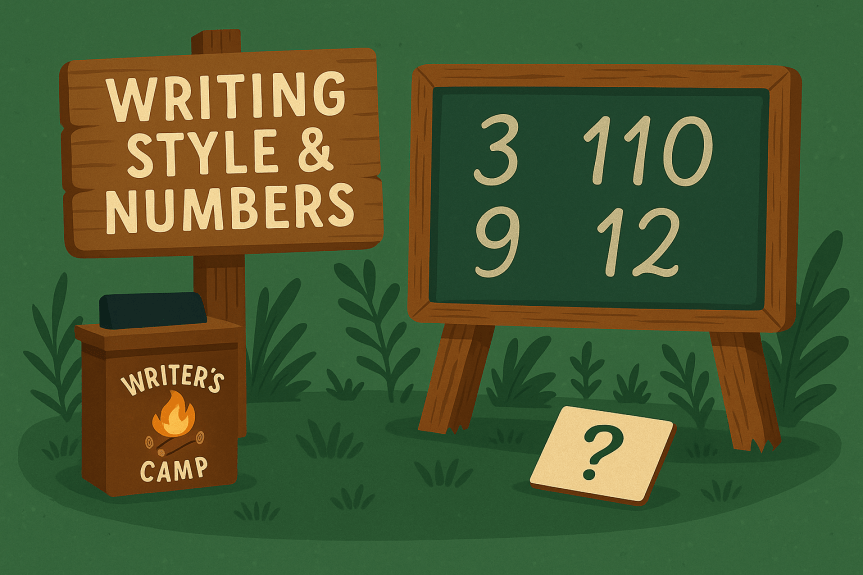
Numbers are crucial for clarity in academic writing, guided by APA and AMA style manuals. Generally, spell out numbers zero to nine and use numerals for 10 and above, with specific exceptions. Mastering these rules enhances editing efficiency and improves the overall presentation of your research, minimizing reviewer criticism.
The Grammar Camp Counselor: Using Which or That—That is the Question

The article explores the grammatical distinction between "which" and "that," emphasizing their roles in restrictive and non-restrictive clauses. It discusses the use of commas as indicators for these clauses, highlights differences in definitions from various sources, and offers practical writing advice for improving clarity and correctness in sentence construction.
LAY vs LIE

The article by Leslie H. Nicoll clarifies the distinctions between the verbs "lay" and "lie." It emphasizes that "lay" requires a direct object, while "lie" does not. The document provides conjugation details and usage examples for both verbs in different tenses, helping readers understand their correct applications in sentences.