

Leslie H. Nicoll, PhD, MBA, RN, FAAN
Writer’s Camp Director
Abstract
Leslie H. Nicoll introduces the Manuscript Math Outline (MMO), a structured approach to writing that emphasizes single-idea paragraphs. Each paragraph serves as a building block, guiding the manuscript’s development while ensuring clarity and organization. Nicoll discusses organizing content and maintaining appropriate manuscript length for publication.
The MMO is a new approach to creating an outline which considers length as well as organization.
I have never been a big fan of traditional outlines. I find them hard to write and for me, they don’t reflect the content of the article I am envisioning. On the other hand, if you try to write a manuscript without some sort of organizing framework, you may end up with big mess. That’s why I’ve invented the MMO: the Manuscript Math Outline. The MMO is based on paragraphs which is why I had you drill down to the paragraph level in the Template Article Analysis that I discussed previously.1
Paragraphs are the Key to Writing
There are two key principles of the MMO:
- Paragraphs are the foundation of your article.
- Every paragraph contains a single idea.
Sounds simple, doesn’t it? And it is simple. Unfortunately, “flight-of-ideas” paragraphs seem to be much more common than single idea ones in papers I receive for editing. So, to start the MMO, let’s talk about single idea paragraphs, how to write them, and how to use them as the building blocks of your manuscript.
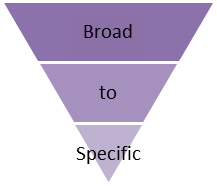
Think of your paragraphs as inverted triangles, as shown in Figure 1. In general, a paragraph should be three to five sentences long. The first sentence introduces the subject of the paragraph and is broadly written. The middle two or three sentences discuss the idea. The last sentence should be specific and act as a segue to the next paragraph. The segue topic has now been introduced and becomes the broad idea that opens the next paragraph. Repeat the process: broad idea, two to three sentences to discuss, get specific, and segue. It sounds sort of like dancing, doesn’t it?
Here’s an example. Imagine you are writing about interventions to manage cancer pain in children. You could introduce the topic in three paragraphs, as follows:
- Paragraph One: Open with a broad statement about pain in illness and narrow it to cancer pain, specifically.
- Paragraph Two: Discuss incidence of cancer pain, 80% to 90% of patients, including children.
- Paragraph Three: Describe incidence of cancer pain in children, why it is important to manage their pain, and why children-focused interventions are needed—to address where children are developmentally.
From there, you might have a paragraph on stages of development, then narrow into the specific age group you studied/are writing about. Thus each paragraph becomes a building block that steps you through the paper, which is built section by section.
Look at the analysis of your template article. You should be able to see how each paragraph leads from the one previously written and builds on the next. That’s what you want to do.
Highlighter Exercise
Try the following: find something you’ve written and get a handful of different colored highlighters. Start with the first sentence. That sentence should introduce the topic of the paragraph. Highlight the major idea and make a note of it. Read sentence number two. Is it on the same topic? If yes, highlight in the same color. If no, highlight in a new color. Make a note of the topic. Now, on to sentence three and then continue until the end of the paragraph. When you finish, ideally, your paragraph should contain only two colors of highlighting. If you have three or four then it is probably safe to say you haven’t focused on the main idea of the paragraph and some editing is needed.
Here’s an example that I edited, which includes my highlighting:
Nurse educators have embraced the teaching and learning technology that human simulators provide. Simulation technology has become an integral component of many nursing education programs despite the lack of data supporting the effectiveness of simulators on student learning outcomes. Although studies abound attesting to the student nurses’ satisfaction using simulators, few studies compare the pre and post simulation learning dynamic. This study examined senior baccalaureate nursing students at the beginning of the pediatric rotation.
Teaching and learning related concepts are highlighted in green; simulation in gold. The paragraph was staying mostly focused on the topic except for the last sentence that seemed to come out of nowhere (highlighted in pink). As such, it was not a good segue.
Let’s look at the next paragraph:
The self-efficacy of senior nursing students’ pre and post participation in two eight hours simulation programs were examined to compare the students’ belief in their ability to provide family centered care at the beginning of the pediatric semester compared to seven weeks later at the end of the semester.
Focus on the first sentence of the next paragraph: self-efficacy. The author selected a student outcome and made it specific, thus it would have been perfect to have this concept introduced in the closing sentence of the first paragraph. I would suggest re-writing the last sentence like this (notice that it has turned into two sentences):
Self-efficacy, that is, a student’s belief that they are able to perform a specific task, is a relevant outcome measure in nursing education. The question that is not answered in the extant research literature is, does a student’s self-efficacy change as a result of engaging in a simulation learning experience?
In these last two sentences, the concept of the outcome measure, self-efficacy, was introduced which then becomes the segue to the next paragraph. With this change, the paragraph has only 3 highlight colors: green (education, teaching learning, students), gold (simulation), and gray (self-efficacy, outcome). Gray will become the dominant color in the next paragraph as self-efficacy and simulation are discussed. What about the baccalaureate students? They’ll get mentioned at the end of this paragraph, making it a smooth transition to the next one, where the participants in the study are introduced.
Single-Idea Paragraphs
Single-idea paragraphs should become the foundation of your writing. It doesn’t matter if you are writing a 3-paragraph memo or a 100 page proposal—each paragraph is a building block that marches you from point A to point B and beyond.
Writing single-idea paragraphs is a skill that can be easily practiced, too. Every time you pick up a pen (or put your hands on the keyboard) stop and ask yourself, “What is the point of this paragraph?” Use that to write the first sentence then flesh out the idea in the subsequent 3 to 5 sentences. Eventually, it will become second nature and you won’t need to think quite as deliberately about each paragraph. There are multiple benefits for being proficient in this writing skill, but 3 come to mind immediately: 1) Your writing will improve dramatically; 2) Your writing, overall, will be more organized; and 3) The writing process will be easier.
Manuscript Math
Now that you are a paragraph expert, let’s put them together and do a little math. Pull out your template article, your Template Article Analysis, and the Information for Authors (IFA) for your selected journal.
Look at the IFA and determine what is the specified manuscript length. In a study with my colleagues, we found that 83% of the journals we reviewed specified manuscript length, either in words (64%) or pages (37%) so you should be able to find this information without too much trouble.2 We editors deal with pages—even online journals have page quotas. Journal budgets are developed based on the number of pages to be published in a year and editors are held to those numbers. Working backwards, X number of pages per year turns into Y number of pages per issue. With Z number of articles per issue, you can calculate Q number of pages per article. For CIN: Computers, Informatics, Nursing, this works out to:
- 672 pages/year (12 issues); which is…
- 56 pages/issue, which is…
- 4 pages for the masthead, table of contents, and editorial; and
- 52 pages for articles, which is…
- 8 articles/issue at 6 to 7 pages per article
Now of course, with those 52 pages, I could have 2 articles of 26 pages each or 13 articles of 4 pages each. But from my experience, 8 articles at 6 pages is the sweet spot—enough to have variety in the issue but at the same time, long enough to convey the information to the reader.
A printed page is roughly 3 manuscript pages (for a journal that is 8.5” x 11”), so 6-7 pages in print means you have 18-21 manuscript pages to work with. For CIN we specify 15 to 18 pages of text which leaves you with 3 to 6 pages that you can allot to the abstract (one page), tables, figures, and references. In CIN, we limit references to a maximum of 50, which is another constraint you must work with.
If your selected journal specifies the length in words, use the following rules of thumb:
- A typical paragraph is 100 to 150 words.
- A page usually has 3 paragraphs, thus 300 to 450 words on a page.
- For a journal that specifies 4000 words: 13 pages or 40 paragraphs.
Look at your Template Article Analysis. How many paragraphs are listed in the “total” box? If your template article is typical for your selected journal, the number should be close to the number you calculated. There’s always a little wiggle room, of course—some pages may have two paragraphs and some may have four—but the basic breakdown should be in the ballpark in terms of numbers.
Another “test” of this math is to look at the length of each article in a selected issue. I would venture a guess that they will all be roughly the same length, i.e., for CIN most articles are about 6 pages long. Remember what I said earlier: editors think in pages and we want to maximize the number of articles in an issue. Manuscripts are supposed to be 15 to 18 pages long. Manuscripts that are too long (usually over 20 pages) will be returned for editing. Pay attention to the paragraphs and how they add up which will help to ensure your manuscript is the right length.
What about the other side of the coin—can a manuscript be too short? In a word: Yes. For a scholarly journal editors expect topics to be covered with sufficient depth to convey the information accurately and thoroughly. In my experience, this can’t be done in 6 or 7 manuscript pages. A total of 13 to 14 pages is probably the lower limit of length that we will consider for CIN. Anything less than that tends to be too skimpy to fully tell the story.
If you happen to select one of the 17% of journals that doesn’t specify manuscript length,2 does that mean you can just go ahead and write whatever you want and ignore all this advice? Sorry, no. Select an issue of the journal and go through and determine the length of all the articles. I imagine they will all be roughly the same. Come up with an average length, then use your manuscript math in reverse to calculate your manuscript length in pages. Again, the number of paragraphs in your Template Article Analysis should correspond to what you have calculated.
Paragraph Building Blocks
Your calculated paragraphs will become the building blocks of your manuscript. Why do I have you organize your article by paragraph? Several reasons. One, remember that you are writing single-idea paragraphs. Having a tight focus for every paragraph keeps you organized and on target. Two, it helps you see where the weight and emphasis should be as you allocate the paragraphs to the various sections. Third, and perhaps most importantly, it can make the writing process feel manageable. If you write one paragraph per day (anyone can write one paragraph!) your article will be finished in X days (your total number of paragraphs). Actually, let’s up the ante a little bit: 3 paragraphs per day (one page) means you can have the first draft done in X days—15 to 18 for an average manuscript, or about 2.5 weeks. Doesn’t that feel doable? And that’s only writing one page per day! You will still have plenty of time for other stuff—but really, is there anything more important than writing?
Armed with this information, you can begin to construct your MMO. Use your Template Article Analysis and fill in the right column. Start broad as you did before. Do the headings that were used in the template work for you? If the journal uses the routine format of Introduction, Background, Method, Analysis, Results, Discussion, Conclusion (often called IMRAD*) then all the headings will be the same. Write those in and then begin to allocate your content to the different sections. Consider where the weight of the article should be. The results and discussion should be the most interesting and thus, longest, parts. Readers (and editors and reviewers) are interested in what you did and care less about what has gone before, that is, the literature review. Unfortunately, too many manuscripts get bogged down in the introduction and background and end up shortchanging the important information.
For those writing a research report, consider carefully how much information you need to include about the method. If you are submitting to a research journal, such as Nursing Research, then you need to include comprehensive information for the reviewers to fully evaluate your study. On the other hand, many journals publish research reports but are not research journals per se. (CIN, as well as the journal I used to edit, the Journal of Hospice and Palliative Nursing are good examples of this.) In this case, you need to include enough information about the research so that it can be accurately evaluated, but you don’t need to go overboard because the design is not the primary purpose or focus of the article. If you are writing a results report for an evidence-based practice and quality improvement initiative, you must follow a guideline for this type of report and ensure you include a discussion of clinical significance,3 a critical area often omitted entirely from these manuscript types. Finding the balance can be a little tricky; I would suggest just getting the draft down on paper first, then edit ruthlessly.4 Having someone else assist you with this can also be helpful.
For those who are visual learners, making a graph of your template article and your proposed MMO can be useful. Here’s an example from the Canadian Journal of Nursing Research article I analyzed previously.5 This article has almost a perfect layout. Most of the content is in the results and discussion, with equal weight given to the other elements. You can see the bell curve in the graph. That is what you want to strive for in your own manuscript.

Figure 2. Graphic presentation of the template article analysis, by paragraph.
Conclusion
And there you have it! Armed with your MMO, you should be ready to write your first draft. Keep your MMO close at hand because this will guide the organization of your article. In the next (and final) installment, I will share some strategies for writing a successful first draft, using all the pieces of the Manuscript Success process that you have learned so far.
*It is a mystery to me why the acronym is IMRAD—it should be IBMARDC. In IMRAD, elements are missing, and the letters are in the wrong order. Of course, it’s not easy to say “IBMARDC.” Just be aware if you see IMRAD, you know what it is referring to.
References
- Nicoll LH. Template Article Analysis: How To Do It. The Writer’s Camp Journal, 2025; 1(2):7. doi:10.5281/zenodo.16507159
- Oermann MH, Nicoll LH, Chinn PL, Conklin JL, McCarty M, Amarasekara S. Quality of Author Guidelines in Nursing Journals. Journal of Nursing Scholarship, 2018;297:1062. doi:10.1111/jnu.12383
- Carpenter R, Waldrop, J, Carter-Templeton H. Statistical, Practical and Clinical Significance and Doctor of Nursing Practice projects. Nurse Author and Editor, 2021; 31(3-4):50-53. https://doi.org/10.1111/nae2.27
- Nicoll LH. Becoming a Ruthless Editor Revisited. The Writer’s Camp Journal. 2025;1(1):1. doi:10.5281/zenodo.15333137
- Owens JK, Nicoll LH, Carter Templeton H, et al. Addressing Nursing Scholarship: A Framework for Currency and Number of References. Canadian Journal of Nursing Research, 2022;54(1):40-50. doi:10.1177/0844562120977410
Author: Leslie H. Nicoll
Reviewed and Edited by: Jayne Jennings Dunlap and Peggy L. Chinn
Copyright © 2025 Writer’s Camp and Leslie H. Nicoll. CC-BY-ND 4.0
Citation: Nicoll LH. The Manuscript Math Outline. The Writer’s Camp Journal, 2025; 1(2):9. Doi:10.5281/zenodo.16644557