

Leslie H. Nicoll, PhD, MBA, RN, FAAN
Writer’s Camp Director
Abstract
Leslie H. Nicoll, PhD, outlines a structured approach to effectively analyze a template article as part of the Manuscript Success Process. Key steps include counting paragraphs, identifying heading levels, and adding paragraphs to sections. This method allows for a clearer understanding of the article’s structure and is crucial for organizing one’s own writing.
Analyzing a published article provides a useful guide for writing a draft.
In my previous article1 I mentioned how my colleague and I “pulled apart” the article we found to use as an example for his article. That first time, that’s exactly what we did but since then, I have refined my approach which has become “Template Article Analysis,” the next step in the Manuscript Success Process.2 In this article, I will review what you need to do effectively analyze your template.
Step One: Count Paragraphs
Of course I have a form, which is included at the end of this article. I also have an example that I have completed, so you can see all of the steps.
The first step, which may seem ridiculous but is important, is to count all the paragraphs in your template article. Go through and count them carefully. You may need to make some rules for yourself. For example, if a paragraph has a bulleted list, is each bullet a paragraph? Or part of the original paragraph? On my table, you can see how I identified questions and bullets. You can do it as I did or come up with your own style. It doesn’t matter what you do, just be consistent.
Step Two: Identify Levels of Headings
The next step is to identify the levels of headings (heads) throughout the article. Mark the Level I, Level II, Level III and (if included) the Level IV and Level V heads. In the article I analyzed (which is from the Canadian Journal of Nursing Research), all the headings are flush left on the page. Level I heads are Bold and Upper and Lowercase (also called Title Case).Level II heads are Bold, Upper and Lowercase, and Italicized. Level III heads are Upper and Lowercase, Italicized, and End with a Period.The text of the paragraph follows immediately after the head (no return). In this template article there are only three levels of heads and there were very few Level III heads. If this was your template, you should probably try to only use three levels, too, in your article. More about that later.
If you are having trouble identifying the correct levels for the headings in your template article, use this trick: Pick a heading you know has to be a Level I head, such as “Methods.” Mark that one, see how it is formatted, and then go through and mark all the other Level I heads. Once you have done that, go back to your first one (ie, Methods) and see what heading is next after that—it will be a Level II head (it has to be). Again, look at the formatting and find all the others that have that same formatting and mark them. Follow this process for Level III, IV, and V (if the levels go down that deep).
Remember that the title of the article is not a heading with a level. It is the title. Likewise, the author byline and any of the other material at the beginning of the article should not be counted as part of your headings. Start with the headings in the text.
I emphasize marking all the headings and having a good understanding of them because when I edit draft manuscripts, mixed-up levels of heads are one of the major mistakes that I repeatedly see and fix. Given that your headings are your structural, organizing framework, it is very important that you understand how they work and use them to organize your paper appropriately.
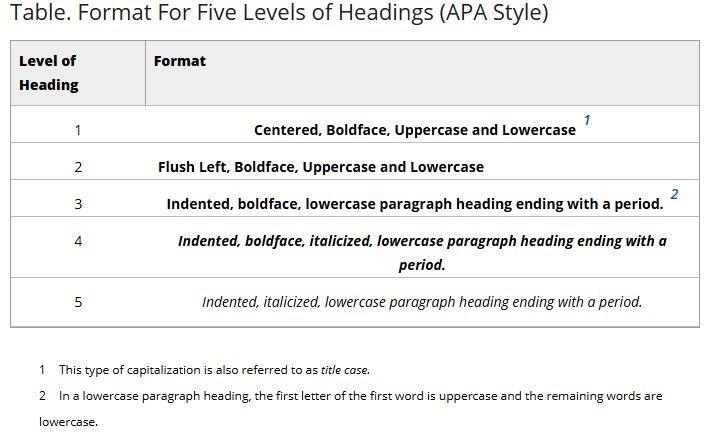
Just to add another layer of confusion: What you see in the journal for formatting may not be what a style guide recommends or requires. For example, the Canadian Journal of Nursing Research uses the APA manual for its style guide. However, if you know your APA headings, you will immediately see that the formatting in the journal does not correspond to the headings in the APA manual. Why? Journal style. All journals are designed and styled to have a certain “look” as well as consistency across all articles. The table in Figure 1 lists the levels of headings and formatting for APA. This also brings up an important point for your writing. If the “Information for Authors” says to use APA style, then that is what you should use, even if the formatting in the journal is different. Make a note of this in your article analysis so you remember how you need to format your headings when you start writing your draft.
One more note: in this template article, the journal formatted it using “stacked heads,” that is, there is a Level I head immediately followed by a Level II head. According to most writing sources, stacked heads are poor writing style and should be avoided. Doing this analysis on my own article, I was surprised to see this since I know know the rule! I couldn’t find our original manuscript in my files, so I don’t know if this is the way we wrote it, or the way it was formatted for publication. Either way, you should avoid stacked heads, even if they appear in your template article.
Step Three: Add Paragraphs to Every Section
Once you have all the headings listed on your table, go through and assign the paragraphs to each section. You may want to go through and identify individual paragraphs to provide more detail that you will use. For example, in my analysis table, “Editor Responses” has 9 paragraphs. Going back to look at the article, this was the section with report of the qualitative findings from the editors’ answers our questionnaire. Each paragraph introduced a theme or sub-theme, with discussion. I could have listed all these and if you see a similar situation, you may want to be more specific, as these paragraphs will become your guide in the next section, the Manuscript Math Outline (MMO).
Step Four: Identify Any Remaining Elements
Last, but not least, note any other elements in the article such as tables and figures. Does the article have any special design elements, such as “callouts” (quotes that are prominently featured) or photographs? As an author, you will probably not be asked to provide photos but you may be asked to come up with two or three callouts if that is part of the journal’s design. This information would be included in the “Information for Authors.”
In our article, there were some “other” elements, as shown in the table. It was interesting to se that only 4 of the 7 authors had ORCiD identifiers; I wonder if we wrote this today if all authors would be required to have an ORCiD.3 I also listed the number of references, figures, and tables.
Conclusion
And that’s it! Admire your table for a few minutes but also consider how it provides a map to the article you have analyzed. You should be able to see the flow from beginning to end. You should also be able to see where the emphasis is—more paragraphs should be allotted to the Methods and Discussion rather than the Introduction and Literature Review. The number of figures and tables also tell a story. Consider all of this as we get ready for the next section, the MMO.
| Template Article Analysis and MMO | |||
| Template Article | # ¶ | Your Planned Article | #¶ |
| Owens JK, Nicoll LH, Carter Templeton H, et al. Addressing nursing scholarship: A framework for currency and number of references. Can J Nurs Res. 2022;54(1):40-50. doi:10.1177/0844562120977410 | 47 (total) | ||
| Abstract: structured (background, purpose, methods, results, conclusions) Keywords: 6 | |||
| Introduction (no heading) | 3 (3 total) | ||
| Background and Purpose (Level 1 head) Appraising Scientific Literature (Level 2) Currency of References (Level 2) | 0 (7 total) 2 5 | ||
| Methods and Procedures (Level 1) Design (Level 2) Data Collection (Level 2) Included 3 numbered questions after paragraph 2 Ethical Considerations (Level 2) Data Analysis (Level 2) | 0 (9 total) 1 6 1 1 | ||
Results (Level 1) Quantitative Findings (Level 2) Review of the Information for Authors. (Level 3) Educator Survey. (Level 3) Qualitative Findings (Level 2) Editor Responses. (Level 3) Included 6 bulleted comments (quotes) Educator Responses (Level 3) | 0 (16 total) 0 2 3 0 9 2 | ||
| Discussion (Level 1) Recommendations (Level 2) – 2 paragraphs with 7 bullet points Limitations (Level 2) | 5 (8 total) 2 1 | ||
| Conclusion (Level 1) | 3 (3 total) | ||
| Other: Declaration of Conflicting Interests (1 sentence)Funding (1 sentence) ORCID iDs for the authors Author Biographies | |||
| References – 16 Figures – 3 Tables – 2 | |||
References
- Nicoll LH. Using a Template Article: Why It Works. The Writer’s Camp Journal, 2025; 1(2):2
- Nicoll L. Manuscript success and choosing a topic. The Writer’s Camp Journal. 2025;1(1):6. doi:10.5281/ZENODO.15443066
- Pickler RH. Why you, and they, need an ORCiD. The Writer’s Camp Journal. 2025;1(2):3. doi:10.5281/zenodo.15836207
Author: Leslie H. Nicoll
Reviewed and edited by: Marilyn Oermann
Copyright © 2025 Writer’s Camp and Leslie H. Nicoll. CC-BY-ND 4.0
Citation: Nicoll LH. Using a Template Article: How to Do It. The Writer’s Camp Journal, 2025; 1(2):7. doi:10.5281/zenodo.16507159