

By Leslie H. Nicoll, PhD, MBA, RN, FAAN
Writer’s Camp Director
Abstract
Selecting the right topic is essential for transforming an ultimate academic paper into a publishable journal article. Writers must avoid merely cutting and pasting their original work; instead, they should rethink their approach, ensuring the manuscript presents novel information tailored to journal standards, while addressing any research flaws honestly.
Ultimate academic papers as topics must be carefully thought through.
Selecting a topic for your article is crucial, as I previously discussed.1 If you have an ultimate paper, such as a dissertation or thesis, or a well-received paper for a class, you may think your topic selection is done. That is true, up to a point, but there are still issues you must consider.
Transforming Your Ultimate Paper
Your “ultimate” paper is the big one—the one you had to write to graduate and receive your degree. It may be called a dissertation, thesis, capstone, scholarly report or something else. For the purposes of this article, I am going to call it the ultimate paper, but you can substitute whatever term applies to your situation.
The ultimate paper is the product of a scholarly project, typically a research study or an evidence-based practice quality improvement (EBPQI) initiative.2,3 It has been written according to university guidelines. It is commonly very long (100 pages or more), with features you would never see in a journal article, such as a Table of Contents, Appendices, and Dedication. It may have many tables and figures and dozens, if not hundreds, of references.
You have poured countless hours into writing this paper and probably shed more than a few tears in the process. Now you are done, and after a breather, it is time to get to work and publish this thing.
Different disciplines have different outcome expectations, but in nursing, it is typical to transform the ultimate paper into a journal article, rather than a book or monograph. As you look at your completed project, you may feel overwhelmed. Where do you begin?
To start, go back to your research study or EBPQI project. That is the first step. Do not fall into the trap of saying, “I am writing an article from my dissertation or DNP capstone.” No, you are not. You are writing an article from the research study or EBPQI initiative that you did. Your ultimate paper is a very different product from what is required for a journal article. When you say you are “writing from” that puts you in the mindset of cut and paste, which is the worst thing you can do. If you try to cut and paste an article, I can guarantee that it will be too long and unorganized. Important points will be missing, and unimportant parts will be over-emphasized.
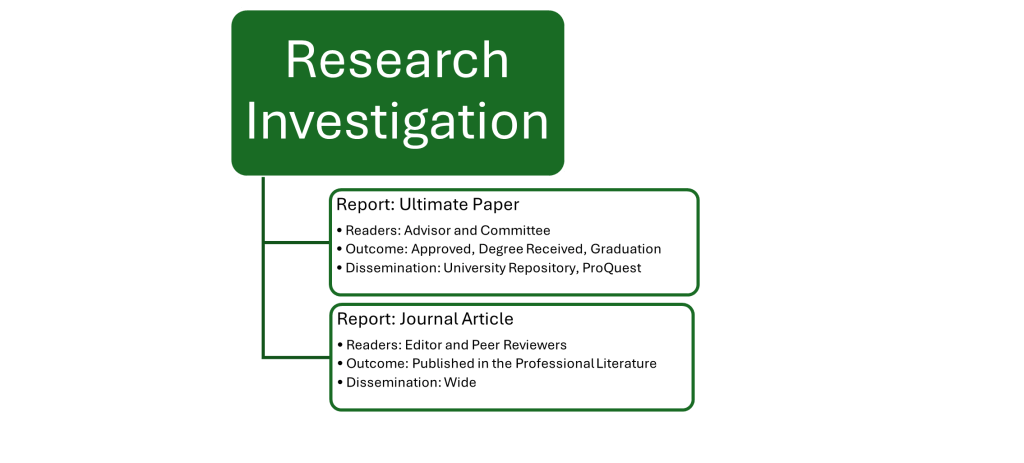
Put your paper away and start from scratch. Think of the research study that you did or the evidence you translated into practice. How can you share your findings in 16 to 18 pages, the typical length of most journal articles? If your study or project was very complex, you may not be able to convey all the information in one manuscript. In that case, consider: where are the divisions? What will be article number one and article number two? As I have said before,1 you might think the topic is obvious, but when you really start to pull it apart, that is not necessarily true.
What you are reading right now is a case in point. I have written about ultimate paper transformation several times.4,5 I re-read those articles, then put them away, let my mind ponder what I wrote, and started from scratch. My goal with the Manuscript Success series here at Writer’s Camp is to update my older work, not just to paste it in and call it done. You should take the same approach with your ultimate paper transformation.
I tell people to put their paper away and start anew. Now, indeed, when you get to statistics, tables, and so on, you can pull it out and use what you have written. Statistics don’t change. But the writing part should be fresh, updated, and tailored to your selected journal.
Be Honest With Yourself
Another point in ultimate paper transformation is to be honest with yourself. Yes, you completed a research study or EBPQI initiative and want to report it in the professional literature. But as a research study or EBPQI project, will it stand up to scrutiny? I once heard a colleague say that learners should not be allowed to do research or evidence translation initiatives that are not publishable. While that sounds like a worthy goal, after I thought about this comment for a while, I wasn’t sure I completely agreed. Why?
Consider that conducting research or translating research evidence into practice in an academic program (typically at the PhD or DNP level) is done to teach you about the research or EBPQI process and how to complete a study or project. It is usually your first independent investigation or culminating activity. Your study or project may be modest in scope, which is appropriate. It is designed to be a learning experience. There may have been things you wanted to do that didn’t work out—maybe you could not recruit enough people to participate, your research instruments turned out to be too complicated, or your EBPQI initiative was not sustainable. That is part of the learning process. Whatever happened, your study or initiative has flaws and limitations, which may be a barrier to publication.
Your advisor and committee worked with you throughout your study or project. They understood the reality of what went on and what you did. Even if the study or project was not perfect, they approved it, after assuring that it met university standards and you demonstrated your learning to them. But a journal article is presented to the editors and reviewers without this background and context. They will likely recognize the flaws and consider that a basis for rejection.
What to do? In this case, I suggest that authors reconceptualize the article they want to write. Instead of writing it as a “pure” research report, re-focus it to deemphasize the research and emphasize, instead, the information that is new and novel. Doing this does require some hard thinking, especially since so many of us have been programmed to think “research = research report.” But editors and reviewers hold research reports to a very high standard. Be honest with yourself on this point. If your study has a flaw (or multiple flaws), don’t be stubborn and keep sending it to research journals only for it to be rejected. Sure, you can try once, but if it comes back quickly, consider rethinking your topic and how it is presented. This is also true for EBPQI initiatives which are often implemented as very small pilot projects over a short amount of time–long enough to meet graduation requirements but too brief to access meaningful clinical significance, impacting journal acceptance. This may also change the journals you consider in your Journal Due Diligence, which I will discuss in an upcoming article.
Academic Paper Transformation
The other case that comes up regularly is when you (or anyone) has written a paper for a class. The professor reads it, gives you a good grade, and says, “This is interesting. You should publish it.” First, be flattered. That’s a great compliment. But then follow up with, “Thank you. Will you help me?”
Unfortunately, too many learners don’t know to ask the follow-up question or if they do, the professor doesn’t follow through with help. That’s too bad because very few learners know what to do in this situation. That’s why you are in school, right? I have heard from several editors who tell of receiving papers that still have the title page with the course number and name, and the grade (always an A, or above 90) written on the front. While that makes for an amusing story, unfortunately, it usually results in a very quick desk rejection.
Academic papers have a very different purpose than a journal article. The former is written to demonstrate to the faculty what you have learned. Typically, this is to show that you know how to search the literature, synthesize what you have read, formulate an argument (or question), and then provide evidence for an answer.
Let’s use the example of heparin versus saline to flush intermittent intravenous catheters, something I wrote about long ago.6 Looking at the literature, I was able to trace the history of how the procedure developed, changes over time (different amounts of heparin at first, then comparing heparin and saline) and finally, I proposed a practice change to use saline only. From this, you can see each of the steps: literature search, synthesis, question, answer.
As an academic paper, it was well received. But for a journal, it needed to be changed. The focus had to shift from demonstrating to faculty what I had learned and instead, providing new information to readers—information that I hoped would be used in practice. An academic paper and a journal article usually have a totally different focus in that respect. If you decide to follow through after your professor’s compliment and suggestion, making this change is the work you must do.
Likewise, an academic paper is often written to conform to guidelines presented in the syllabus, which generally are not the same as the “Information for Authors” in a journal. You need to consider length, number of references, style of references, and format of the overall paper, which includes headings and structure. Perhaps your professor required the paper to be written according to journal guidelines, and if so, you are one step ahead. But based on my experience, I can still guarantee that you have work to do.
Conclusion
Topic selection is crucial to publishing success. Even when you think the topic is obvious, there may be nuances that you need to carefully consider when you formulate your manuscript. With an ultimate or academic paper, don’t jump to cut and paste and think you are done. Your paper won’t be good, and you will be discouraged. Take time to think through what you are working with and craft your topic accordingly.
References
- Nicoll LH. Manuscript success and choosing a topic. The Writer’s Camp Journal, 2025;1(1):6. doi:10.5281/zenodo.15443066
- Waldrop J, Dunlap JJ. The Mountain Model for Evidence-Based Practice Quality Improvement Initiatives. American Journal of Nursing. 2024;124(5):32-37. doi:10.1097/01.NAJ.0001014540.57079.72
- Dunlap JJ, Waldrop JB, Brewer TL, Mainous RO. Differentiation and integration of research, evidence-based practice, and quality improvement. Journal of Nursing Education. 2024;63(9) doi:10.3928/01484834-20240514-01
- Nicoll LH. MS: Manuscript Success: A Systematic Approach to Publishing in the Nursing Literature. 2012. Bristlecone Pine Press.
- Nicoll LH. Transforming the ultimate paper: hints for authors. Nurse Author & Editor. 2017;27(4):1-9. doi:10.1111/j.1750-4910.2017.tb00252.x
- Nicoll LH. Heparin versus saline as a flush solution in intermittent intravenous devices. Research Review, 1990;6(5):2-3.
© 2025 Writer’s Camp and Leslie H. Nicoll. CC-BY-ND 4.0
Author: Leslie H. Nicoll
Editor: Jayne Jennings Dunlap
Citation: Nicoll LH. Academic papers: considerations in topic selection. The Writer’s Camp Journal, 2025;1(1),8. https://doi.org:10.5281/zenodo.15522536
One thought on “Academic Papers: Considerations in Topic Selection”